

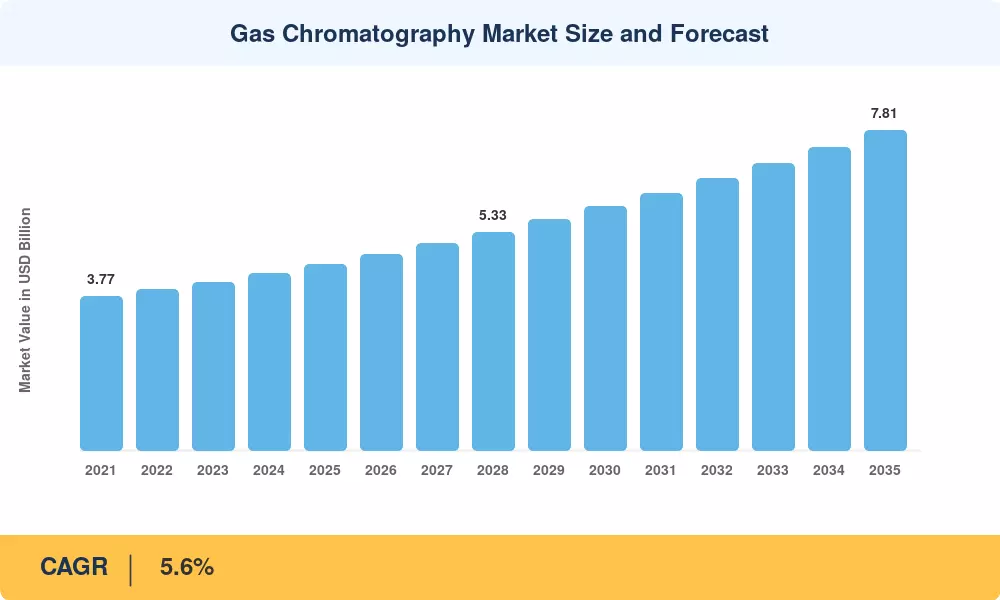
Gas Chromatography Market to reach USD 7.81 Billion by 2035 at 5.6% CAGR
Gas Chromatography Market,
Gas Chromatography Market to Surge from USD 4.53 Bn in 2025 to USD 7.81 Bn by 2035—By Stricter Pharmaceutical Quality Mandates, Hydrogen Carrier-Gas Transition
NY, CA, UNITED STATES, August 28, 2026 /EINPresswire.com/ -- As per Market Research Future, the global Gas Chromatography Market size is projected to reach USD 7.81 Billion by 2035 from USD 4.53 Billion in 2025, at a CAGR of 5.6% during the forecast period 2026–2035. The market base was estimated at USD 4.53 Billion in 2025, with the first year of the forecast period (2026) valued at USD 4.78 Billion.The 5.6% CAGR—anchored by structural shifts in analytical testing and regulatory enforcement—is propelled by three converging forces: tightening pharmaceutical quality mandates from the U.S. FDA and European Medicines Agency (EMA), which continue to push capital expenditure toward next-generation separation platforms; expanded environmental monitoring programs under the U.S. EPA's Clean Air Act enforcement, requiring more frequent field-level testing and funneling procurement budgets into portable and bench-top chromatography units; and the technology shift from legacy packed-column instruments to high-efficiency capillary systems, with laboratories worldwide transitioning carrier gases from scarce helium to hydrogen and nitrogen.
Global regulatory bodies and industry initiatives are amplifying this momentum. The FDA's updated Current Good Manufacturing Practice (cGMP) guidance now requires residual solvent profiling for every batch of injectable drug products, directly expanding installed GC capacity across contract testing laboratories. EMA Annex 1 revisions, effective since August 2023, mandate enhanced contamination monitoring in sterile manufacturing environments, pushing European pharmaceutical firms to upgrade aging chromatography fleets. The U.S. Department of Energy allocated approximately USD 42 million in 2024 for hydrogen infrastructure research, part of which supports safe hydrogen-ready analytical instrument development. These forces are creating the procurement infrastructure and innovation on which the Gas Chromatography Market depends.
Request A Free Sample:
https://www.marketresearchfuture.com/sample_request/31118
Key Market Trends & Growth Drivers
Pharmaceutical Quality Mandates
The FDA's updated cGMP guidance now requires residual solvent profiling for every batch of injectable drug products, a rule that directly expanded installed GC capacity across contract testing laboratories in 2024. EMA Annex 1 revisions, effective since August 2023, mandate enhanced contamination monitoring in sterile manufacturing environments, pushing European pharmaceutical firms to upgrade aging chromatography fleets. These regulatory tailwinds are generating USD 680 million in incremental instrument demand through 2028 alone, according to industry procurement tracking data.
Environmental Monitoring Expansion
The U.S. EPA's enforcement of Method 325B for fence-line monitoring of benzene at petroleum refineries created a captive market for continuous ambient-air GC units, with approximately 150 refinery sites adding or upgrading monitoring stations between 2023 and 2025. Europe's REACH regulation revisions under the European Chemicals Agency require expanded volatile organic compound profiling for an additional 2,400 chemical substances by 2027, broadening the analytical workload for industrial and contract laboratories across Germany, France, and the Nordic countries.
Hydrogen Carrier-Gas Transition
Global helium spot prices surged 35% between 2022 and 2024, accelerating laboratories' switch to hydrogen as a carrier gas. Major vendors including Agilent Technologies and Shimadzu now ship hydrogen-ready configurations as default on flagship platforms, and hydrogen generator sales grew 22% year-over-year in 2024. This shift lowers annual per-instrument carrier-gas costs by approximately USD 3,200 while improving separation speed by 20–30%.
Mass Spectrometry Detector Integration
Coupling GC with mass spectrometry condenses separation and identification into a single analytical run, cutting sample turnaround time by up to 45% in pesticide residue screening workflows. Thermo Fisher Scientific reported that GC-MS system orders grew 18% in fiscal 2024, driven primarily by food-safety and forensic toxicology laboratories. Laboratories that previously operated standalone GC and separate MS units are consolidating onto hyphenated platforms, reducing bench-space requirements and technician labor hours.
Ask for Customization:
https://www.marketresearchfuture.com/ask_for_customize/31118
Market Segment Insights
BY INSTRUMENT TYPE
Systems: Largest segment with approximately 41% share in 2025, reflecting sustained demand for fully integrated bench-top and floor-standing platforms across pharmaceutical quality-control laboratories. Agilent's 8890 and Shimadzu's Nexis GC-2030 platforms have captured significant procurement share by offering seamless helium-to-hydrogen switching.
Portable & Micro-GC: Fastest-growing instrument category at 10.1% CAGR (2026–2035) , fueled by field-based environmental and oil-and-gas applications. These compact units deliver laboratory-grade separation in field conditions, making them essential for EPA fence-line monitoring and upstream oil-and-gas leak detection.
Detectors: Significant segment at USD 0.91 Billion in 2025, driven by replacement cycles and MS detector integration.
Auto-Samplers: Growing at 6.8% CAGR (2026–2035) , driven by throughput optimization in high-volume laboratories.
BY ACCESSORIES & CONSUMABLES
Columns: Largest segment with approximately 49% share in 2025, driven by recurring replacement cycles and rising capillary column adoption. The shift toward low-phase-ratio capillary columns is boosting average selling prices by 15–20% relative to legacy packed columns.
Gas Generators: Fastest-growing segment at 9.0% CAGR (2026–2035) , as laboratories transition away from helium supply contracts.
Other Consumables: Growing at 4.8% CAGR (2026–2035) , including syringes, vials, and sample preparation kits.
BY DETECTOR TYPE
Flame Ionization Detector (FID): Largest segment with approximately 34% share in 2025, favored for hydrocarbon and organic compound screening due to universal sensitivity to carbon-containing compounds and low maintenance requirements.
Mass Spectrometry Detector: Fastest-growing segment at 10.7% CAGR (2026–2035) , reflecting the growing need for definitive compound identification. Regulatory agencies increasingly require MS detection for confirmatory testing in pharmaceutical and food-safety workflows.
Thermal Conductivity Detector (TCD): Significant segment at USD 0.38 Billion in 2025, used for inorganic gas analysis.
Electron Capture Detector (ECD): Growing at 4.2% CAGR (2026–2035) , used for halogenated compound trace analysis.
BY END USER
Pharmaceutical & Biotechnology: Largest segment with approximately 32% share in 2025, driven by residual solvent and impurity profiling. The FDA's cGMP framework requires residual solvent testing per ICH Q3C across all dosage forms.
Environmental Testing Agencies: Fastest-growing end-user at 9.7% CAGR (2026–2035) , as governments expand air, water, and soil monitoring mandates worldwide.
Oil & Gas: Significant segment at USD 0.68 Billion in 2025, driven by refinery process control and emissions monitoring.
Food & Beverage: Growing at 6.4% CAGR (2026–2035) , driven by pesticide and mycotoxin screening.
Academic & Research Institutions: Significant segment at USD 0.36 Billion in 2025, supported by government-funded research grants.
Read Detailed Insights:
https://www.marketresearchfuture.com/reports/gas-chromatography-market-31118
Regional Outlook
North America — Dominant Market (~38.5% Share, 2025)
United States: Generates approximately 78% of North American revenue, anchored by dense pharmaceutical and petrochemical testing networks. Supported by more than 12,000 accredited analytical testing laboratories and a pharmaceutical sector that spends approximately USD 85 billion annually on R&D.
Canada: Growing at 5.8% CAGR, driven by cannabis legalization testing infrastructure.
Mexico: Contributes USD 0.07 Billion in 2025, driven by petrochemical refinery modernization.
Europe — Second Largest (~28% Share, 2025)
Germany: Holds 24% of regional share, driven by chemical industry and automotive emissions testing.
United Kingdom: Growing at 5.4% CAGR, driven by post-Brexit independent regulatory capacity.
France: Contributes USD 0.17 Billion in 2025, driven by pharmaceutical manufacturing expansion.
Italy: Growing at 4.8% CAGR, driven by food and beverage quality certification.
Spain: Contributes USD 0.09 Billion in 2025, driven by olive oil and wine adulteration screening.
Nordic Countries: Growing at 5.1% CAGR, driven by environmental monitoring leadership.
Russia: Contributes USD 0.06 Billion in 2025, driven by petrochemical refining analytics.
Rest of Europe: Growing at 4.5% CAGR, driven by EU-wide REACH compliance harmonization.
Asia-Pacific — Fastest-Growing Region (9.0% CAGR, 2026–2035)
China: Holds 34% of regional share, driven by pharmaceutical API manufacturing QC. China's pharmaceutical manufacturing sector supplies more than 40% of global active pharmaceutical ingredient volume.
India: Fastest-growing in the region at 10.2% CAGR, driven by environmental enforcement and generic pharma exports. The Central Pollution Control Board expanded mandatory stack emissions monitoring to 900 industrial units in 2024.
Japan: Contributes USD 0.19 Billion in 2025, driven by precision instrumentation and food safety.
South Korea: Growing at 7.8% CAGR, driven by semiconductor manufacturing cleanroom monitoring.
ASEAN: Contributes USD 0.08 Billion in 2025, driven by food export certification.
South America — Growing Presence (USD 0.27 Billion, 2025)
Brazil: Anchors the region at 58% of revenue, driven by Petrobras refining analytics and food exports.
Argentina: Growing at 5.2% CAGR, driven by agricultural export testing.
Middle East & Africa — Emerging Opportunity (5.5% CAGR, 2026–2035)
Saudi Arabia: Leads the region with 30% of regional share, driven by Vision 2030 petrochemical diversification.
UAE: Growing at 6.2% CAGR, driven by free-zone analytical service centers.
South Africa: Contributes USD 0.03 Billion in 2025, driven by mining effluent monitoring.
Egypt: Growing at 5.8% CAGR, driven by pharmaceutical manufacturing growth.
Competitive Landscape and Recent Developments
The Gas Chromatography Market exhibits moderate concentration, with the top five players accounting for an estimated 62–68% of global revenue. Competition centers on detector integration breadth, consumable ecosystem lock-in, and post-sale service networks.
KEY COMPANIES AND RECENT MILESTONES
Agilent Technologies: Broadest GC portfolio with strong pharma/environmental installed base. Estimated ~18–22% revenue share.
Shimadzu Corporation (June 2024): Released the GCMS-QP2050, featuring a redesigned ion source that improves sensitivity 3× over its predecessor, targeting trace-level pesticide residue analysis. Estimated ~12–16% revenue share.
Thermo Fisher Scientific: Hyphenated MS integration and forensic workflows. Estimated ~10–14% revenue share.
PerkinElmer (Revvity): Headspace and thermal desorption specialization. Estimated ~6–9% revenue share.
Bruker Corporation: High-resolution petrochemical and environmental applications. Estimated ~4–7% revenue share.
Danaher Corporation: Consumable ecosystem and service revenue. Estimated ~4–6% revenue share.
Restek Corporation: Column innovation and method development tools. Estimated ~3–5% revenue share.
LECO Corporation: Time-of-flight GC-MS for complex matrices. Estimated ~2–4% revenue share.
Recent Industry Developments:
U.S. EPA (March 2024): Finalized updates to Method 325B for continuous fence-line benzene monitoring, expanding the number of refineries required to deploy ambient-air GC systems from 120 to 150 sites.
European Medicines Agency (August 2023): Enforced revised Annex 1 guidelines for sterile manufacturing, mandating enhanced environmental monitoring via GC-based contamination screening across EU pharmaceutical plants.
Future Outlook: 2026–2035
The Gas Chromatography Market is projected to reach USD 7.81 Billion by 2035, growing at a CAGR of 5.6%, driven by pharmaceutical quality mandates, environmental regulation expansion, and the hydrogen carrier-gas transition.
New opportunities lie in:
AI-Driven Method Development and Autonomous Laboratories: Machine-learning algorithms can now optimize column selection, temperature programs, and detector parameters in minutes rather than days, reducing human intervention by up to 70% by 2032.
Sustainable Carrier-Gas Ecosystems: By 2030, fewer than 25% of new GC installations will specify helium as the primary carrier, down from roughly 60% in 2024, aligning with broader ESG commitments to reduce Scope 3 supply-chain emissions.
Miniaturization and Decentralized Testing: Micro-GC and chip-based separation platforms will bring analytical capability closer to the point of need, with the International Energy Agency anticipating decentralized emissions monitoring will experience a tenfold increase by 2035.
Platform Economics and Recurring Revenue Models: Hardware vendors are shifting toward platform business models that bundle instruments with cloud-based data management, consumable subscriptions, and predictive maintenance contracts.
Emerging-Market Laboratory Buildout: Countries across the Middle East and sub-Saharan Africa are investing in domestic testing capacity, with Saudi Arabia's Vision 2030 including 14 new analytical laboratories for petrochemical quality control.
By 2035, the Gas Chromatography Market is expected to demonstrate robust growth, reflecting evolving regulatory requirements, technological innovation, and the continued expansion of analytical testing capacity worldwide.
More Related Research Insights:
https://www.marketresearchfuture.com/reports/bioinformatics-market-2265
https://www.marketresearchfuture.com/reports/dental-consumables-market-1806
https://www.marketresearchfuture.com/reports/dental-3d-printing-market-6260
https://www.marketresearchfuture.com/reports/chemiluminescence-immunoassay-analyzers-market-8783
https://www.marketresearchfuture.com/reports/healthcare-software-as-a-service-market-29747
https://www.marketresearchfuture.com/reports/fertility-services-market-6281
https://www.marketresearchfuture.com/reports/process-analytical-technology-market-2338
https://www.marketresearchfuture.com/reports/laboratory-proficiency-testing-market-26273
https://www.marketresearchfuture.com/reports/healthcare-regulatory-affairs-outsourcing-market-7804
https://www.marketresearchfuture.com/reports/bone-graft-substitutes-market-1195
Market Research Future
Market Research Future
+1 855-661-4441
email us here
Legal Disclaimer:
EIN Presswire provides this news content "as is" without warranty of any kind. We do not accept any responsibility or liability for the accuracy, content, images, videos, licenses, completeness, legality, or reliability of the information contained in this article. If you have any complaints or copyright issues related to this article, kindly contact the author above.
